Of all the nature topics we explore as an outdoor family, the butterfly life cycle might be the most magical. There’s something about watching a creature completely transform itself – from a tiny egg to a munching caterpillar to a beautiful butterfly – that never gets old, no matter how many times you explain it to a kid.
Spring is the perfect time to learn about it because butterflies are actually out there doing it right now! This article walks through all four stages of the butterfly life cycle for kids in simple language, paired with a free printable trifold brochure you can use at home, in the classroom, or on a nature walk.
Table of Contents
Watch It First – Butterfly Life Cycle Video for Kids
I always love pairing a video with a printable when teaching nature topics – the video gives kids a visual first, and then the printable helps the information really stick. This SciShow Kids video is one of the most recommended butterfly life cycle videos for ages 6-8. It’s about 4 minutes, uses animation and real photos, covers all four stages clearly, and even explains what butterflies taste with (spoiler: it’s their feet!)
Watch together first, then read through the stages below and use the free printable to review what they learned!
The 4 Stages of the Butterfly Life Cycle
Like frogs, butterflies are animals that go through metamorphosis – a dramatic transformation from one form into a completely different one. The butterfly life cycle has four stages, and each one looks completely different from the last. The whole process takes about 4-8 weeks depending on the species and the weather.
Stage 1 – The Egg 🥚
Every butterfly starts as a tiny egg laid on a leaf. The mother butterfly doesn’t just pick any leaf – she carefully chooses the exact right plant that her caterpillar will need to eat when it hatches. Different butterfly species use completely different plants!
Butterfly eggs can be round, oval, or ribbed and are often tinier than a pinhead. They’re coated in a sticky substance so they stay put on the leaf even in the wind. Eggs hatch in just 3-7 days!
Key facts about butterfly eggs:
- Laid on the underside of leaves to hide them from predators
- Each butterfly species prefers specific plants
- Monarch butterflies only lay eggs on milkweed!
- A monarch can lay up to 700 eggs in her lifetime
Stage 2 – The Caterpillar (Larva) 🐛
When the egg hatches, out comes a tiny caterpillar – also called a larva. The caterpillar has one job and one job only: EAT! It munches on leaves almost constantly, growing so fast that it has to shed its skin (called molting) up to five times.
Some caterpillars grow to be 100 times bigger than they were when they first hatched – all in just 2-3 weeks! All that eating stores up the energy the caterpillar will need for its incredible transformation ahead.
Key facts about caterpillars:
- Hatches hungry and starts eating immediately
- Sheds its skin up to 5 times as it grows
- Can grow 100 times its hatching size in 2-3 weeks
- Each butterfly species looks like a completely different caterpillar
- Stores energy for the chrysalis stage
Stage 3 – The Chrysalis 🫘
When the caterpillar is fully grown, it does something extraordinary – it forms a chrysalis (say: KRIS-ah-lis), a hard protective shell that it hangs from a branch or leaf. This is NOT the same as a cocoon – a cocoon is made by moths from silk, while a butterfly chrysalis forms from the caterpillar’s own skin!
Inside the chrysalis, the caterpillar’s body almost completely dissolves into a liquid soup before rebuilding itself into a butterfly. This process takes about 10-14 days. Near the end, the chrysalis often turns transparent so you can see the butterfly forming inside!
Key facts about the chrysalis:
- Hangs from a branch, leaf, or fence – pretty much anywhere!
- The outer shell hardens to protect the butterfly inside
- The caterpillar’s body essentially melts and rebuilds
- Wings, legs, antennae, and eyes all form during this stage
- Often turns transparent at the end – you can see the butterfly inside!
Stage 4 – The Adult Butterfly 🦋
The chrysalis cracks open and out comes a beautiful adult butterfly! At first its wings are wet and crumpled from being folded up inside the chrysalis. The butterfly must hang and wait, pumping fluid into its wings until they dry and stiffen enough to fly. This takes about an hour!
Adult butterflies drink nectar from flowers using a long curled tongue called a proboscis (say: pro-BOS-is) – kind of like drinking through a straw. As they visit flowers collecting nectar, they carry pollen from plant to plant, helping plants reproduce. This is called pollination and it’s one of the most important jobs in nature!
Key facts about adult butterflies:
- Wings must dry for about an hour before first flight
- Drinks nectar through a long curled proboscis
- Pollinates flowers as it feeds
- Tastes with its feet – special sensors tell it if a flower is sweet!
- Will lay eggs to start the cycle all over again
Fun Butterfly Facts for Kids
- 🦋 Butterflies taste with their feet! Sensors on their legs tell them if a leaf or flower is good before they even taste it with their mouth
- 🦋 There are about 20,000 species of butterflies in the world
- 🦋 Monarch butterflies migrate up to 3,000 miles every year!
- 🦋 A butterfly’s wings are covered in tiny scales that reflect light to create their colors
- 🦋 Butterflies are cold-blooded and need the sun to warm up before they can fly
- 🦋 The biggest butterfly in the world has a wingspan of nearly 12 inches – as wide as a ruler!
- 🦋 Butterflies can only fly when their body temperature is above 86°F
What’s the Difference Between a Chrysalis and a Cocoon?
This is one of the most common mix-ups kids (and adults!) make, so it’s worth clearing up! A chrysalis is formed by butterflies – it’s made from the caterpillar’s own hardened outer skin. A cocoon is made by moths – they spin themselves a silky case using silk from glands in their body. So butterflies make chrysalises, and moths make cocoons. Both serve the same purpose but are made completely differently!
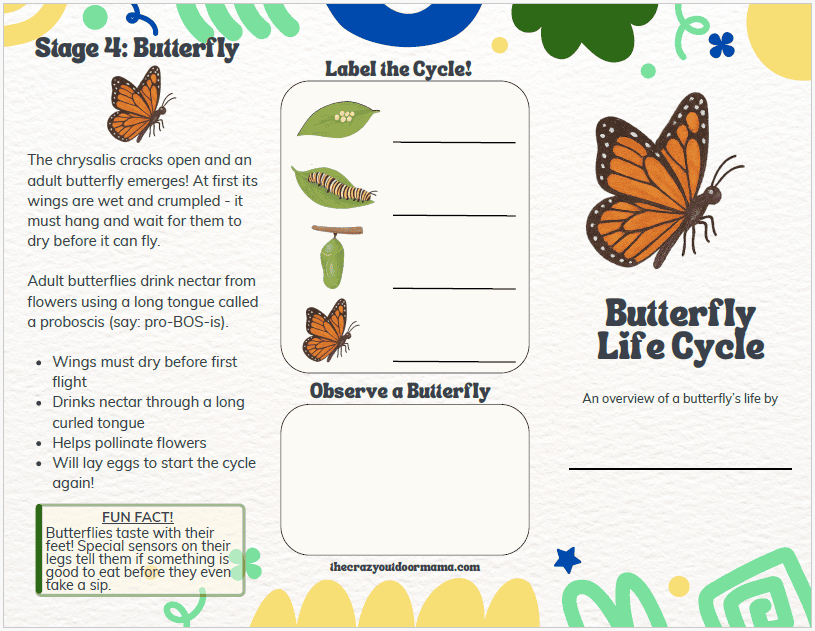
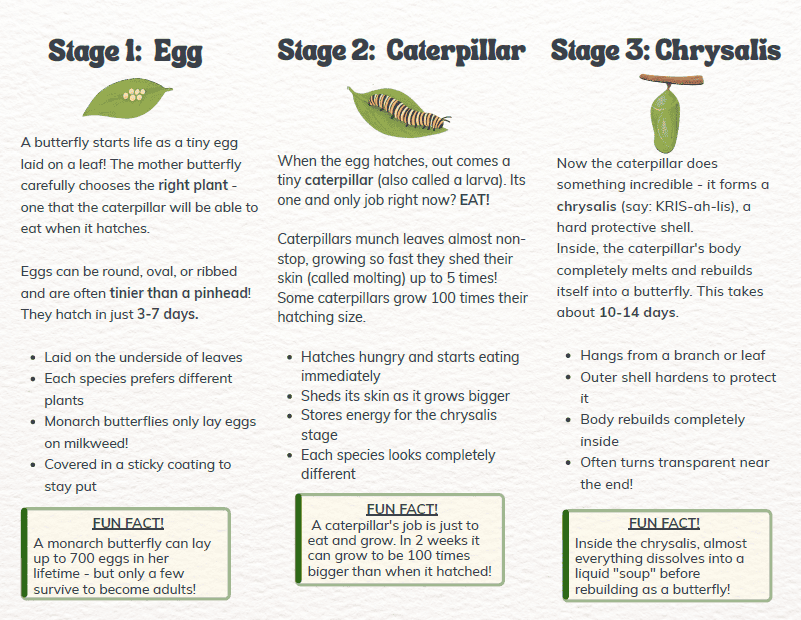
Free Printable Butterfly Life Cycle Brochure
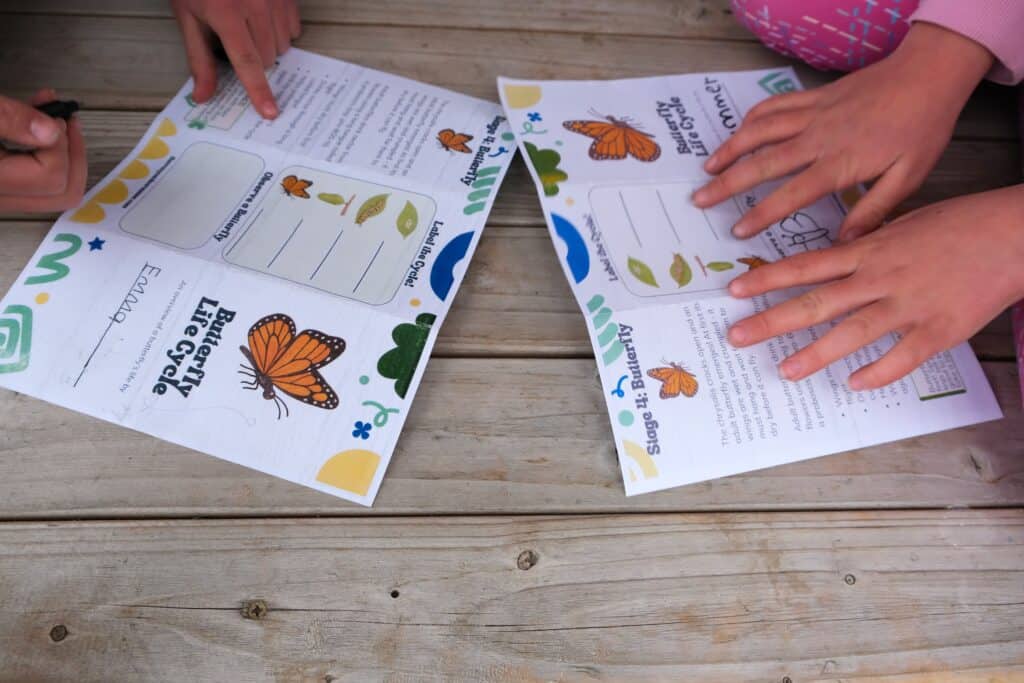
Almost every butterfly life cycle printable out there costs money – this one is completely free! This trifold brochure covers all four stages with kid-friendly explanations, fun facts, illustrations, a label-the-cycle diagram, and a quiz. Designed for ages 6-8 and perfect for:
- Home learning and homeschool science units
- Pairing with the SciShow Kids video above
- Spring nature walks – bring it along to look for caterpillars and chrysalises!
- Classroom and after-school activities
Download the Free Butterfly Life Cycle Printable Here!
To print: Open the PDF, set your printer to landscape orientation on 8.5×11 paper, and print double-sided. Fold into thirds for a brochure! Cardstock gives the best results but regular paper works great too.
How to Find Butterflies and Caterpillars in Spring
Spring is the best time to spot butterflies actively going through their life cycle. Here’s what to look for:
- Eggs: Check the undersides of leaves, especially milkweed for monarchs. Look for tiny round or oval specks, often in clusters
- Caterpillars: Look on plants and leaves – check for chewed leaf edges and follow the damage to find the caterpillar nearby
- Chrysalises: Check under branches, fence rails, and the undersides of leaves – they can be green, brown, or gold colored to blend in
- Adult butterflies: Visit flowering gardens, meadows, and anywhere with wildflowers on warm sunny days
Bring a magnifying glass and the brochure on your next spring walk and turn it into a full butterfly science lesson outdoors!
Extension Activities to Go With the Printable
Raise a Butterfly at Home
Nothing brings the butterfly life cycle to life like watching it happen in front of you! Butterfly raising kits from companies like Insect Lore come with live caterpillars and everything you need to watch them transform into painted lady butterflies. It takes about 3-4 weeks from caterpillar to butterfly and is one of the most memorable nature experiences a kid can have. You release the butterfly at the end!
Playdough Butterfly Life Cycle
Give kids four colors of playdough and challenge them to sculpt each stage – a tiny round egg, a long caterpillar, a hanging chrysalis, and a butterfly with outstretched wings. Arrange them in a circle on a paper plate to show the cycle. This hands-on approach helps the stages really stick, especially for younger kids.
Butterfly Garden Nature Walk
Take the learning outside with a free printable spring scavenger hunt – add “butterfly,” “caterpillar,” and “chrysalis” to the list! Pair it with the brochure for a complete spring nature learning combo.
Act Out the Life Cycle
Have kids act out each stage – curl up tiny like an egg, wiggle and crawl like a caterpillar munching leaves, wrap arms around themselves tightly like a chrysalis, then burst out and flutter around like a butterfly! A great movement break that doubles as a science review.
Plant a Butterfly Garden
Spring is the perfect time to plant flowers that attract butterflies! Milkweed (for monarchs), lavender, coneflower, and marigolds are all great choices. Let kids take ownership of a small patch or container garden and watch butterflies visit all summer. It connects the life cycle learning to real conservation – your garden actually helps butterflies survive!
Butterfly Life Cycle Books to Read Alongside
- National Geographic Readers: Caterpillar to Butterfly– stunning real photos and age-appropriate facts perfect for ages 6-8
- The Very Hungry Caterpillar by Eric Carle – a classic that perfectly introduces the life cycle concept to younger siblings
- Waiting for Wings by Lois Ehlert – beautiful illustrations showing the full cycle from egg to butterfly
Frequently Asked Questions
What are the 4 stages of the butterfly life cycle?
The four stages of the butterfly life cycle are egg, caterpillar (larva), chrysalis, and adult butterfly. The process of transformation from one stage to the next is called metamorphosis. It begins when a female butterfly lays eggs on a plant, and ends with a fully formed adult butterfly that will eventually lay its own eggs and start the cycle again.
How long does the butterfly life cycle take?
The full butterfly life cycle takes roughly 4-8 weeks depending on the species and the weather. Eggs hatch into caterpillars after 3-7 days, caterpillars feed and grow for 2-3 weeks, the chrysalis stage takes 10-14 days, and then the adult butterfly emerges. Warmer temperatures speed the process up – spring and summer butterflies develop faster than fall ones.
What is the difference between a chrysalis and a cocoon?
A chrysalis is formed by butterflies from their own hardened outer skin – no silk involved. A cocoon is made by moths, which spin themselves a silky case using silk from glands in their body. They serve the same purpose but are made completely differently. Butterflies make chrysalises, moths make cocoons!
When is the best time to see butterflies in spring?
Butterflies are most active on warm, sunny spring days when temperatures are above 60°F. The best time of day is late morning through early afternoon when they’ve had a chance to warm up. Look in flower gardens, meadows, and anywhere with wildflowers – butterflies follow the nectar!
The butterfly life cycle is one of those topics that genuinely amazes kids every single time – the idea that a caterpillar essentially melts and rebuilds itself into something completely different is almost impossible to believe! Pair the video, this article, and the free printable together for a complete spring learning experience your kids will remember.
Have you spotted any caterpillars or chrysalises in your yard this spring? Drop a comment below – I love hearing about what everyone is finding out there!
More spring nature activities your kids will love:
- Frog Life Cycle for Kids (Free Printable Brochure!)
- Free Printable Spring Scavenger Hunt for Kids
- Build a Nest Activity for Kids (+ Free Scavenger Hunt Printable)
- 15 Fun Dandelion Crafts for Kids
- 50 Spring Activities for Kids